I noticed that there are seemingly hundreds of Reddit threads with people asking how much the hot tub they have (or want to have) is going to cost to keep hot1,
2,
3,
4,
5,
6,
7,
8,
9,
10,
11,
12,
13,
14,
15,
16,
17,
18,
19,
20
Most are not very helpful. As one person put it, it's actually a really complicated thermodynamics question with a lot of variables.
There are also a bunch of existing online "calculators" that are worse than useless (mostly low effort SEO spam. The phrase "not even wrong" comes to mind)1,
2,
3,
4,
5,
6.
Sounds like a challenge! I have built a full discrete event simulation that allows you to estimate how different assumptions will impact monthly energy use and cost. I tried to calibrate and sanity check it with empirical data I could find, and it's pretty good! You can play with different assumptions below to see how it affects the result. I'll also talk about how the model works at the end.
I found that reasonable setups can lead to monthly costs ranging from $8 to over $300. The oft quoted $30 per month (a dollar a day!) hides a lot of potential variability.
There were some common questions that seem to come up over and over again that we can now try to answer more quantitatively: How much less efficient is a 110V plugin models vs hardwired 220V? Does turning the hot tub's set point down when not in use make a big difference? How much more does a big tub cost to heat than a small one?
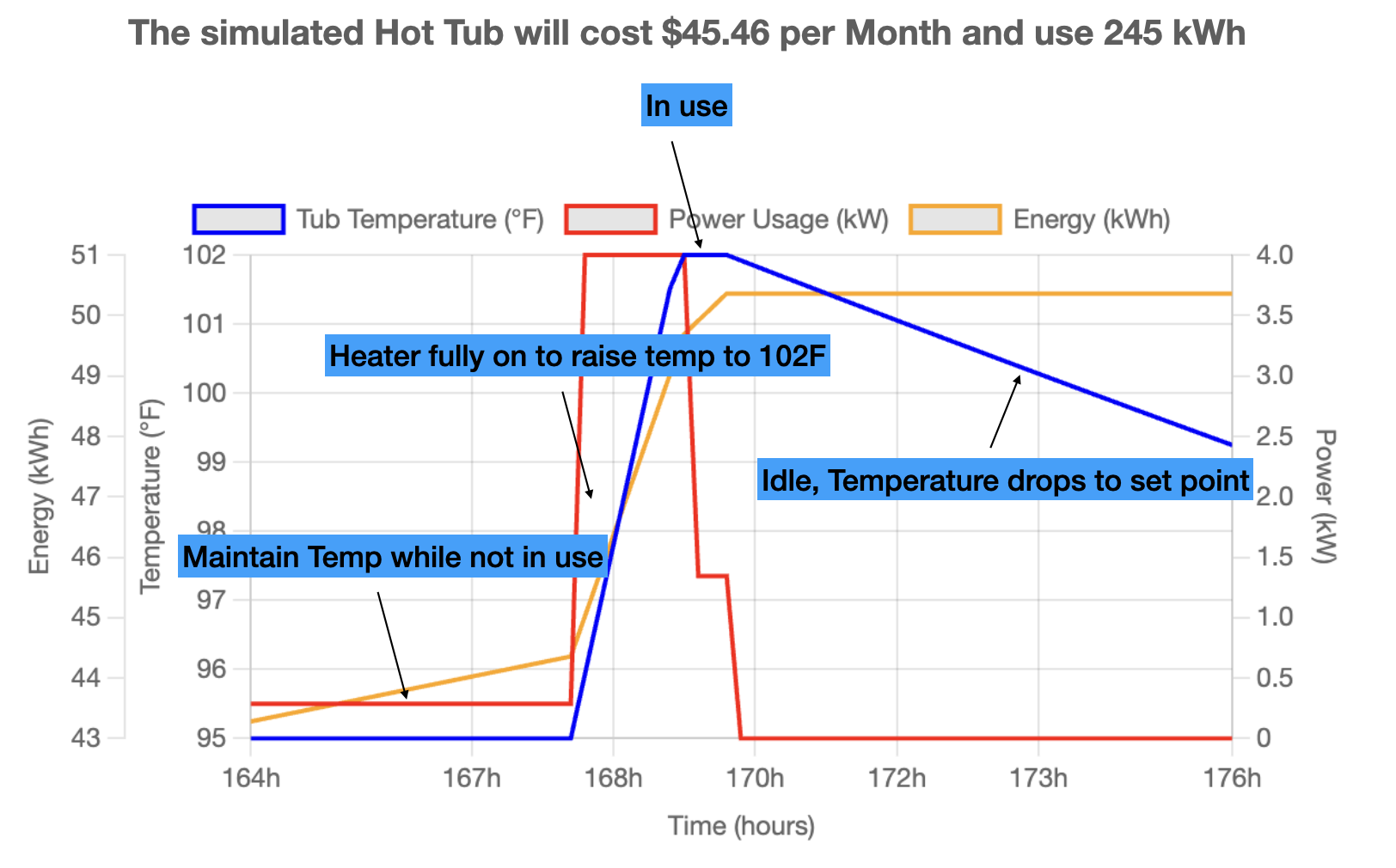
Simulation output showing hot tub energy use and temperature over time for one use cycle. You can run your own simulation below.
The Hot Tub Energy Calculator
Heating Inputs
These inputs control how quickly your tub's heater can raise the temperature and how much energy it uses to do so.
Usage inputs
These inputs set how you use your hot tub. If you drop the temperature when not in use =, you'll save energy but less if you use it a lot since every time you use the tub you will have to reheat it to the desired temperature.
Hot Tub Insulation/Efficiency
These inputs control how well the hot tub can maintain its temperature (i.e when your set point is below the current temp to let it drift down). A lower efficiency setting means faster temperature drops as does lowering the average outside/ambient temperature the hot tub is exposed to. The thermal decay model is discussed below.
The In Use multiplier is how much quicker relative to the normal drop rate the tub loses heat when in use with the cover off.
Model assumptions derived from your inputs
Based on your tub's efficiency, tub size, and the average ambient temperature, this is how quickly your tub will cool down. (full curve is available in the Temperature Decay model discussion)
Based on your tub's efficiency, tub size, and heater power, this is how quickly your tub's temperature will rise when the heater is on.
Energy Cost
If you have expensive electricity you will be more sensitive to differences in energy usage.
Results
About the model
The chart below shows the full simulation of the power use and temperature of the hot tub (it defaults to showing the first 2 weeks of the month).
The model is a basic discrete event simulation with the following states
Maintain Temperature: Heater is assumed to run at some duty cycle (see below for explanation) needed to keep the temperature near the desired set point to match the drop assumed by the temperature decay model.
Rise to Use Temp: When hot tub is used (frequency determined by number of times per week input), the heater is assumed to turn on fully and the temp will rise based on the temperature rise model (see below).
In Use: Energy consumed is calculated similarly as maintain temperature state but at a higher duty cycle needed to keep at Usage Temp plus some additional power for jets.
Idle: Tub's temperature is allowed to drop to the set point. Drop rate follows temperature decay model. Assume negligible energy use during this period.
The simulator simulates a month of heating/using/idle cycles computing the energy needed to get the tub in each state. Below is a description of the thermodynamic model assumptions. (the code is easily accessible by viewing source in browser.)
Temperature decay model
The simulation uses a simple exponential temperature decay model (Newton's Law of Cooling) based on the efficency input to set the decay factor of the hypothetical tub.
Based on the efficiency level you set above and the ambient temperature, this is the full temperature decay curve that will be used by the model for the drop in temperature over time (as well as rate of drop). If you change the efficiency setting above the chart will update.
Temperature Rise Model
The temperature rise model uses the specific heat of water, the size of the tub, and the power of the heater to determine how fast temperature will increase. It also accounts for the amount of heat loss while the tub is being heated. The heat being removed from the system due to losses derived from the temperature decay model above is subracted from the heat being added from the heater. The difference causes the water to heat up based on it's specific heat. I didn't expect this to match as well as it did when I experimented with my own tub (which has 1kW and 4kW modes and can be filled with different amounts of water). I was prepared to use someting more empiriically derived/handwaved but the physical model worked quite nicely.
Notes: Having a plugin tub will heat more slowly than a hardwired tub, and you might think that a 4kW heater would heat 4x as fast as a 1kW plugin, but this is not quite the case. The reason this is not the case is the tub is losing heat to the environment which the heater has to fight against. If the tub did have 0 heat loss and a 1 kW heater could heat 1.5 degrees per hour, than a 4kW heater would heat the water 4x as fast at 6 degrees per hour. But if tub is losing .5 degrees per hour due to heat loses, you'll net out at 1 degree per hour and 5.5 degrees per hour respectively. A more efficient tub would do better, but plugin models with small heaters also tend to be less efficient at retaining heat so this can be a bigger factor than you think. (In the limit where heat loss equals gain it would take an infinite amount of time and energy to reach the set point.)
The rate at which the heater can increase the temperature also impacts the how hard it will have to work to maintain a given temperature. In other words the temperature increase model is used to determine the duty cycle needed to balance the losses from temperature decay model (relevant during Maintain and In Use states). Here the size of the heater makes less of a difference, as long as your heater is big enough to maintain the current set point it doesn't really matter whether it comes from a small 1 kW heater or a 4 kW
An additional component that affects energy use is the direct power losses due to overhead. When the heater is on, some of the energy is wasted (running circulation jets, running heater electronics). The default fixed 150W overhead means when you are running a 1kW heater you are really using 1.15kW (so about 87% efficient). For a 4kW heater, this same overhead would mean you would be getting 4kW of useful heating out of 4.15kW input (~96% efficiency). This is about a 10% difference on its own in addition to the heat loss affect above.
The above two reasons are why the hot tub salesman will tell you a hardwired tub is more efficient than a low powered plug in. Though we'll see that a lot of the savings have more to do with being able to lower the set point when not in use (if desired) and the fact that that $4000 plug-in tub you bought from Costco is going to have worse insulation than the $12000 tub you bought from Hot Springs or Bull Frog.
Some Results
Default Scenario
For an efficient, hardwired 300-gallon hot tub operating on 240V—maintained at 102°F and used 5 times per week—the simulator estimates an energy consumption of about a bit under 200 kWh per month. This is right at about the average quoted by the National Spa and Pool Institute That's about $30 a month assuming electricity costs $.15 per kWh (close to the national average).
When a less efficient tub will cost you...
On the other hand, a cheap 300-gallon plug-in model with below average insulation, kept at 102°F and used five times per week would consume over 400 kWh per month, almost double the "average" case above. In regions with high electricity rates—such as California’s Bay Area or San Diego, where rates can be around $0.75 per kWh—this level of consumption could lead to monthly bills exceeding $300.
What you can do...
You could get a small, energy efficient, two-person hot tub, only use it once per week and lower temperature to 90°F when not in use. And move to North Dakota. The simulator estimates a monthly consumption of less than 100 kWh in this scenario which will result in a monthly bill of around $7 assuming rates are ~$.1 per kWh. That's a big swing and illustrates why simple rules of thumb are not very useful because they are unlikely to apply to your situation.
Comparison: 120V Plug-in vs. 240V Hardwired Models
I had a relatively cheaper plug-in tub similar to the less efficient section above (in an expensive area costing big bucks). It was convertible to 240V so I was interested to see how much could be saved by upgrading so it could use the 4kW heater. There were some nominal direct savings due to better heating efficiency but the bigger gain was the ability to lower the set point when not in use (it's not practical to lower the set point on a plugin as it takes so long to heat up). Power use dropped from a over 315 kWh per month to under 250kWh, inline with the model.
It seems many hot tub salesman recommend keeping the temperature at the desired level at all the times. This seems to be true for tubs that are better able to maintain their temperature. If you live in an area with reasonable electricity rates and have an efficient tub, the difference might only be an additional few dollars per month to have your tub ready to go at all times. Lowering the set point on my cheap model will save around $40 per month though so the answer really depends!
What about the California Energy Commision's MAEDbS database?
There is a database of all hot tubs that can be legally sold in CA that lists standby power. Critically, the standby power in that database includes the power to keep the hot tub at 102F when not in use assuming a test temperature of 56F. So supposedly, if you look up your tub in that database and find the standby power and multiply by 24*30/1000 you'll get kwh used per month if you don't use it. 150mW standby would mean 108 kWh per month.
This could potentially be a good way to get a more precise parameter for your tub's efficiency input for the model to find overall energy use. Unfortunately, I'm skeptical that the data in that database is useful for practical scenarios (Maybe I'm missing something though). I pulled up some data for a bunch of high end tubs made by Hot Springs (MSRP ~ $20,000) and compared them to Aquaterra, a popular lower end roto-molded Costco/Home Depot brand (MSRP ~ $5,000), and they look... kind of similar? The manufacturer of both is Watkins. Doesn't seem right to me. I did want to link to that database since it's potentially interesting information.
Incidentally, Hot Springs has a calculator that seems to be based on measured data for their tubs. Their test assumed the tub was used 6 times a week for 30 minutes. The various tubs I tried at different sizes match pretty well with the model if you assume an efficient tub. (I don't see how it aligns with the standby data in the CEC database). I'll update this if I get additional information...